
Your Builder Has Overrun. What Now?
A 32-week programme that ran close to two years. What to do first when a London build has stalled: stop paying, check the record, measure what is covered up.
- 4.8★ Google · 16 reviews
- £500 per week if we finish late
- £17m insurance cover · £5m public liability
- 12-month warranty on second-fix fittings · HomePro registered
- £550 survey credited in full
Konrad, a homeowner we filmed, had agreed a 32-week programme. The job ran close to two years, on a house they were paying rent to stay out of, and the finishing work we inherited took six weeks. They tell that story themselves in the film — it is worth the half hour if you are living it. This is the part that comes after: what to actually do, in order, when the programme has stopped meaning anything.

Konrad’s kitchen, finished. The conversation in the film happens across this island, in the house the job was supposed to have handed over two years earlier.
The instinct is to push harder on the person who is already late. That almost never works, because by the time a build has overrun badly the problem is usually not effort. It is that the money and the work have come apart.
1. Stop paying against a programme that no longer exists
Most stalled jobs share one mechanic: payments were tied to dates or to round percentages rather than to work standing on site. Once money has run ahead of progress, the contractor has no commercial reason to return, and you have no leverage left to make them.
Our own terms exist because of this. You pay 10% to mobilise and then weekly, against work already done — with 5% of the price held back until the end of the 12-month defects period. The reasoning is in the payment-schedule guide. Whatever your contract says, the question to answer today is simple: what have you paid, and what is physically there for it?
2. Find out what building control has actually been told
This is the step people skip, and it is the one that decides whether you have an unfinished build or an unrecorded one.
Under regulation 12(2) of the Building Regulations 2010, a person intending to carry out building work must give the relevant authority either a building notice under regulation 13, or an application for building control approval with full plans under regulation 14. Under regulation 16(1), they must not start that work unless notice of intention to start has been given and at least two days have elapsed since the end of the day the notice was given. Regulation 16(3C) requires a further notice, not more than five days after work is regarded as commenced.
Ring your local authority's building control department, quote the address, and ask what exists. One of three answers comes back: a live application with inspections recorded, a live application with nothing inspected, or nothing at all. They are three different problems and they cost different amounts to fix.
3. The expensive part is what is already covered up
Regulation 16(3) lets the authority, having received notice of intention to start, require notification at specified stages — and 16(3)(b)(ii) lets it specify a period during which the work concerned must not be covered up. Under 16(3A) it may only specify a stage it actually intends to inspect, and 16(3B) says that intention rests on its assessment of the risk of a breach.
The plain reading matters here. The regulations anticipate that some work must be left open to be looked at. On a job that stalled, that is precisely what did not happen: plasterboard went on, screed went down, and nobody came.
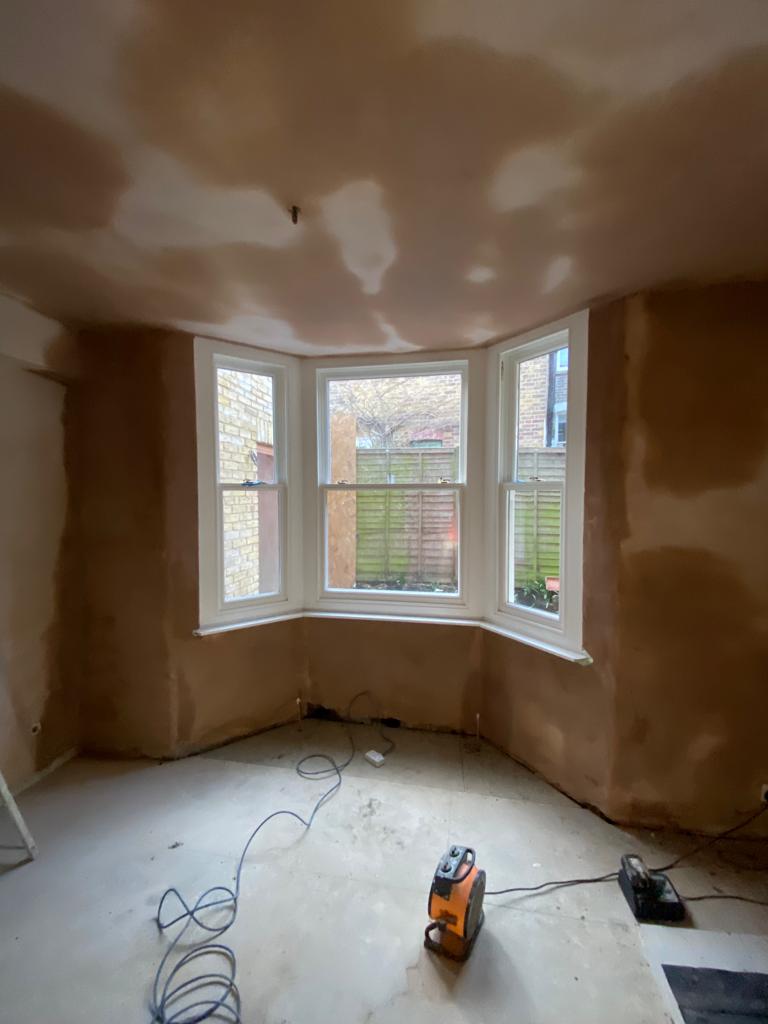
So a contractor taking the job over is asked to stand behind work they cannot see. No honest one will. Parts of it get opened again — a section of ceiling, a run of floor, the top of a wall — and it is that reopening, not the remaining build, that produces the number people do not expect. It is also why a price quoted over the phone for finishing a stalled job is worth nothing.
4. Get it measured before anyone quotes to finish it
A survey on a stalled build is doing something different from a survey on an empty room. It is separating three things: what is finished and sound, what is finished and wrong, and what was never started. Only the third of those is ordinary building work. The first two are the argument.
Ours is credited in full against the build if you go ahead, and what it costs is on the booking page. What it produces is a measured schedule of what exists, which is the document every other conversation — the next contractor's price, your insurer's questions, your solicitor's if it goes that way — is going to need.
5. What the contract to finish it has to fix
The one thing a rescue contract must do that the original did not is commit to a date. We finish on the agreed date, or we pay you for every week we are late — the date is in the contract, and only a variation you approve can move it. After two years of dates that moved for free, that is the whole point.
Two other things belong in it. Every variation priced and signed before the work happens, so the number cannot drift while your back is turned. And a payment schedule that stays behind the work, for the reason in step 1.
What we cannot help with
Recovering money you have already paid is a legal question, not a building one. It turns on your contract, what the payments were for, and what was delivered. We do not give legal advice and will not pretend otherwise.
What we can do is establish what is actually on site and what it is worth. That evidence is useful to you whoever finishes the job — including if that is not us.
If you want a range for the work that is genuinely left, the estimator prices it stage by stage. If you would rather someone looked at it first, that is what the survey is for. And if you are earlier than this — still choosing — the checks in how to avoid a bad builder take an afternoon and remove most of the risk you can remove before signing.
Straight answers
The home you actually want, finished on the date in the contract — and you watch every day of it happen from your phone.
You answer 3 questions. We do the drawings, planning, party wall, trades and snagging.
- 10% to mobilise, then weekly against work already done — with 5% held past handover: 2.5% released at practical completion and 2.5% at the end of the 12-month defects period
- £550 survey fee credited in full against your contract
- Every variation priced and signed before a penny is spent
No email needed to see your range. Quotes hold for 21 days, then materials re-price.
We are not the cheapest. If price is the only factor, we may not be the right fit — and that is fine.
Keep reading
- Kitchen Renovation Cost in London 2026The build stack for a London kitchen is £8,807 and barely moves. The product stack swings six-fold. Which half your quote is arguing about decides everything.
- Bathroom Renovation Cost in London 2026: Every LineA full strip-out and re-tile of a 4.08 m² London bathroom is £11,387 of build work before you choose a tap. Every line, net of VAT, with the clause behind each rule.
- When Repointing Has Failed, and What Goes BackCement pointing on a soft London brick sends the damage into the brick instead of the joint. How to read a failed joint, and the mix that goes back.
- Extend or Just Renovate: One House, Two PricesWe priced the same Battersea terrace twice — with the rear extension and without. The gap was £38,532 and four weeks, and 68% of it sat in two trades.